Memory
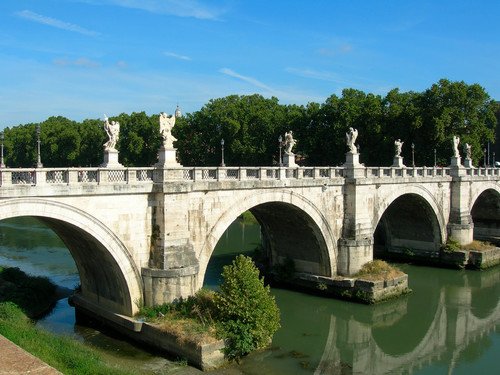
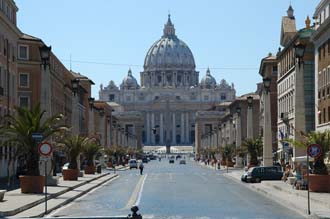
The Tiber River. Dirty, brown, and prone to flooding, I love it. The sidewalks along the Tiber are open, light, and often void of pedestrians. Jogging along the river fed my spirit. The silvery grays and greens reminded me of Frodo's journey down the Anduin River after leaving Lothlórien, and the statues on the Ponte Sant'Angelo alluded to the statues of the ancient kings of Gondor. There was something majestic about my little morning jaunt down the river. My favorite part was on the way home, after turning around, when I had a direct view down Via della Conciliazione toward St. Peter's Piazza. With my hands on my knees, attempting to breathe deeply, I would have a look at St. Peter's, and just take a little moment to thank God for another beautiful day.
On my last night in Rome I did my walk one last time; the walk from the Campo de' Fiori along the Tiber to St. Peter's. Darkness changes the river from brown to velvety black. At night I have the river to myself and I feel as though the river is mine. Like always, I turned off towards the piazza one bridge before Castel Sant'Angelo. St. Peter's Basilica at night is the most spectacular sight. I knew I'd have to come at night to have a moment alone with Peter. The loud, obnoxious tourists and swarms of pilgrims during the daylight hours had made it impossible for me to say a proper goodbye before going home. The night was clear and beautiful, and the piazza was empty. I stayed for over an hour before the security drove me away.
Coming home was easier said than done for a variety of reasons. It took me 41 hours to get home, which I wasn't prepared for. When I saw the Space Needle through my airplane window I cried a little bit. Picking up with my relationships here in Seattle turned out differently than I'd expected, and I found myself disappointed and frustrated with what I came home to. I have gone from thinking of Rome as a break from the confusion and stress of my daily life, to a bridge between two ways of being. Rome taught me how to take care of myself, to live on my own, cook my own food, live with people whom I don't necessarily relate to easily, and take responsibility for myself. These are skills that I took home with me, and effect the way that I relate to my friends here.
Although I can't spend my mornings running along the Tiber River or my evenings wandering around St. Peter's Piazza, I have already begun to find new places and routines here at home that give me that same sense of space and peace.
Monday, March 29, 2010

Saturday, March 13, 2010
Writing Assignment #9
"What and who is Italian?"
"Who and what is American?" I can't address the first question without also acknowledging the second. As with anything in life, my perspective on Italy, the way that I perceive the culture and people is almost exclusively a result of my own experiences and ideas of what is normal. The observations I make are comparisons between Italy and what I know, which is my life as an American in Seattle. "The Other" is a dynamic term, dependent completely on perspective. What is for one person the Other, is for another customary and familiar. I can only speak for myself, and one quarter in this country has made Italy into more of an "Other" to me than it was before I came. The more time I spend in this country, the less I can relate to the people. As I learn more about Italian culture and identity, the differences rather than the similarities are what seem to continue to grow and become more apparent. My previous belief has always been that the more one knows about the Other, the more they are able to relate and understand them. For whatever reason, this has not been true in my experience here in Italy.
Italy is.. pizza, pasta, wine, Fiats, scooters, bikes, boots, shiny puffy jackets, cobblestones, colors, hand gestures, old men and women, tradition, art, and history, Italians... my imagery of Italy. Despite my high expectations for the aesthetic appeal of Italy, I was not disappointed. Italy is a beautiful country. However, I am forced to once again bring up bella figura because it is the most accurate way of describing Italians. The general fixation with outward appearance and superficial impressions is everywhere; vanity is rampant. It feels to me like there is a desire to prove true the stereotypical imagery that the world has about Italy. As much as the Romans seem to hate tourists, they are devoted to maintaining the tourists' fantastical idea of Rome. Italy can seem so posed at times, even in places that are off the beaten track. I think I say this because I am slightly put off and even disturbed by how consistently unsurprised I am. Italians continue to do what I expect them to do. Even after experiencing the differences between the north and the south, and feeling the surprising kindness of the Southerners, I have not been surprised. Sure their behavior towards me was different in Naples than it was in Rome, but the Italians themselves are more or less the same to me. The stereotypes about the Neapolitans are different than those about the Romans, but the culture of both cities remains more or less the same. They eat slight variations of the same foods, wear the same shiny puffy coats and leather boots, drive Fiats and Smart Cars, smoke cigarettes like there's no tomorrow, and take their shots of espresso at the bar. I can't recognize any differences in dialect or accent, although I know they exist. The focus on tourist appeal is prevalent in Italy, whether it is the blatant tourist menu at the restaurant or the seasonal reparation and renovation period that occurs in the winter off-season. The restaurants, museums, monuments, all get their beauty treatment and face lifts in the winter so they can look good for the hoards of tourists in the summer months.
Bella figura. This word has changed the way that I view my own culture in the United States as well. I have thought about how much of American culture and identity is based on outward appearance and superficial impressions. Americans have the same fixation, but manifested in a very different way. The culture of the United States is defined as one of immigrants, a diverse and new population of people who are rooted elsewhere. Even with this identity, we have had brutal slavery, extreme racism and segregation, and continue to struggle with the incorporation of so many cultures and backgrounds. Acknowledging this, allows me to have more understanding and grace for the Italians. They are some of the more racists cultures I have encountered, but they have not had the practice that we Americans have had. They haven't made all of the mistakes that we've made. The Italians are new to this game, new to the concept of diversity, and wary of the intrusion of the Other into their traditional culture. Not only have the Italians had less experience with diversity, they have a much older and deeply rooted culture to begin with that they are intent on preserving. Americans wiped out what was already there, allowing them to started fresh and build a brand new culture and identity for themselves without the fear of destroying something sacred.
So although I find that the more I learn about Italians the more separate and foreign they seem to me, I suppose I am able to understand better why they are the way they are. As I learn more about the history of Italy, I am able to come closer to understanding the reasons for their behavior and account for what I see as weaknesses in their culture. I am not trying to sound elitist when I say weaknesses, but to point out that there are pieces of Italian culture that I see as backward and in need of reform, an example being their rejection of immigrants. Globalization is happening whether they like it or not, and immigrants will continue to influence and change their culture; it is inevitable that the Italians will have to at some point recognize this and learn to incorporate the newcomers.
Italy is many things. There are pieces of Italy that I will presumably bring home with me and see in a new light after having left. Leaving and returning has been a theme this quarter, and I expect the same trends that I've experienced leaving and returning from Rome to hold true with Italy and Seattle. I am confident that my idea of who and what is Italian will continue to evolve even after leaving Rome and returning home.
"Who and what is American?" I can't address the first question without also acknowledging the second. As with anything in life, my perspective on Italy, the way that I perceive the culture and people is almost exclusively a result of my own experiences and ideas of what is normal. The observations I make are comparisons between Italy and what I know, which is my life as an American in Seattle. "The Other" is a dynamic term, dependent completely on perspective. What is for one person the Other, is for another customary and familiar. I can only speak for myself, and one quarter in this country has made Italy into more of an "Other" to me than it was before I came. The more time I spend in this country, the less I can relate to the people. As I learn more about Italian culture and identity, the differences rather than the similarities are what seem to continue to grow and become more apparent. My previous belief has always been that the more one knows about the Other, the more they are able to relate and understand them. For whatever reason, this has not been true in my experience here in Italy.
Italy is.. pizza, pasta, wine, Fiats, scooters, bikes, boots, shiny puffy jackets, cobblestones, colors, hand gestures, old men and women, tradition, art, and history, Italians... my imagery of Italy. Despite my high expectations for the aesthetic appeal of Italy, I was not disappointed. Italy is a beautiful country. However, I am forced to once again bring up bella figura because it is the most accurate way of describing Italians. The general fixation with outward appearance and superficial impressions is everywhere; vanity is rampant. It feels to me like there is a desire to prove true the stereotypical imagery that the world has about Italy. As much as the Romans seem to hate tourists, they are devoted to maintaining the tourists' fantastical idea of Rome. Italy can seem so posed at times, even in places that are off the beaten track. I think I say this because I am slightly put off and even disturbed by how consistently unsurprised I am. Italians continue to do what I expect them to do. Even after experiencing the differences between the north and the south, and feeling the surprising kindness of the Southerners, I have not been surprised. Sure their behavior towards me was different in Naples than it was in Rome, but the Italians themselves are more or less the same to me. The stereotypes about the Neapolitans are different than those about the Romans, but the culture of both cities remains more or less the same. They eat slight variations of the same foods, wear the same shiny puffy coats and leather boots, drive Fiats and Smart Cars, smoke cigarettes like there's no tomorrow, and take their shots of espresso at the bar. I can't recognize any differences in dialect or accent, although I know they exist. The focus on tourist appeal is prevalent in Italy, whether it is the blatant tourist menu at the restaurant or the seasonal reparation and renovation period that occurs in the winter off-season. The restaurants, museums, monuments, all get their beauty treatment and face lifts in the winter so they can look good for the hoards of tourists in the summer months.
Bella figura. This word has changed the way that I view my own culture in the United States as well. I have thought about how much of American culture and identity is based on outward appearance and superficial impressions. Americans have the same fixation, but manifested in a very different way. The culture of the United States is defined as one of immigrants, a diverse and new population of people who are rooted elsewhere. Even with this identity, we have had brutal slavery, extreme racism and segregation, and continue to struggle with the incorporation of so many cultures and backgrounds. Acknowledging this, allows me to have more understanding and grace for the Italians. They are some of the more racists cultures I have encountered, but they have not had the practice that we Americans have had. They haven't made all of the mistakes that we've made. The Italians are new to this game, new to the concept of diversity, and wary of the intrusion of the Other into their traditional culture. Not only have the Italians had less experience with diversity, they have a much older and deeply rooted culture to begin with that they are intent on preserving. Americans wiped out what was already there, allowing them to started fresh and build a brand new culture and identity for themselves without the fear of destroying something sacred.
So although I find that the more I learn about Italians the more separate and foreign they seem to me, I suppose I am able to understand better why they are the way they are. As I learn more about the history of Italy, I am able to come closer to understanding the reasons for their behavior and account for what I see as weaknesses in their culture. I am not trying to sound elitist when I say weaknesses, but to point out that there are pieces of Italian culture that I see as backward and in need of reform, an example being their rejection of immigrants. Globalization is happening whether they like it or not, and immigrants will continue to influence and change their culture; it is inevitable that the Italians will have to at some point recognize this and learn to incorporate the newcomers.
Italy is many things. There are pieces of Italy that I will presumably bring home with me and see in a new light after having left. Leaving and returning has been a theme this quarter, and I expect the same trends that I've experienced leaving and returning from Rome to hold true with Italy and Seattle. I am confident that my idea of who and what is Italian will continue to evolve even after leaving Rome and returning home.
Friday, March 5, 2010
Writing Assignment #7/8
Naples
Contradictions! We have thrown around the word so much this quarter I feel silly using it, but I can't define my impression of Naples any other way. I set off for Naples anticipating a dirty, fast-paced, and harsh city. These expectations, although somewhat informed, were rooted in the stereotypes that I'd read so much about and heard firsthand from Italians here in Rome. Although the divisions within Italy are both numerous and extreme, the north-south divide seems to be the most pronounced and deeply rooted in history. Southern inferiority is a common thread in most conversations about racism, social divisions, or even food or soccer. In "Images of the South" the author addresses the many layers of this dynamic, and says "These images are constructed within the North-South dialogue, but the Southerners are the first to believe them and appropriate them" (84). At first I applied this statement to the stereotypes about the illegal activity and lack of safety in the south. After having spent a few nights in Italy's South, I interpret this sentence differently. The Italians in the South do draw a line between themselves and the North; a clear, distinct line. But the Neapolitans are the most free spirited Italians I've come across. They do what they want, and seem to enjoy their status as the underdog. The Neapolitans don't think of themselves as inferior, but rather seem proud of their identity as the rebellious and anarchic ones.
Alexander Valentino was our charming, scruffy guide through the city. I was fascinated by Alexander, and intrigued by his views on Naples, Rome, and Italy as a whole. As someone who has lived in both Naples and Rome, he has a more informed perspective on the cultural differences. I learned a lot from Alexander. He talked to me about the Roma in Italy, and the way that they are perceived and accepted. According to Alexander, the further North you go in Italy, the more racist the people get. "Oh the Venetians! They're the worst!" My experiences in the North support this idea. Alexander described the Southerners as a more humane, empathetic people, "We don't believe in God. We believe in humans." He went on to say a few words about the corruption in the Catholic church; he's clearly not a big fan. Alexander was able to articulate in a way that I couldn't the energy and culture of the Roman people. He described the culture in Rome as one "with no meat". He talked about the general lack of culture in Rome due to its lack of a substantial core. "Rome is all periphery now. The historical center surrounded by periphery." He addressed an overall laziness that the Romans have developed due to their security as the historical center of Italy, of Europe. The food is notoriously bad in Rome, the waiters notoriously rude. Alexander described their mentality for me, "They think, 'If you don't want the food, the next tourist will.'" Everything he said about the Romans resounded with me; it was in many ways a relief to have someone put words to my general confusion and disappointment with the people of Rome, if I can even say "the people of Rome". I guess that is in a large part the problem; there is not a clearly defined people of Rome. As Alexander said, Rome is overrun. It is overrun by immigrants and tourists, and corrupted by its role as the 'golden child' of Italy. Rome embodies the idea of bella figura. Rome is undoubtedly full of rich history and art, but the true face of modern day Rome is far from the pretty facade.
It's hard to articulate what it is I liked so much about Naples. I'm sure Alexander Valentino added to my positive impression of the city, but there was something more. It was the little interactions with the waiters, shopkeepers, and people on the streets that struck me. After so many interactions with rude waiters and impatient shop-keepers, the kindness and compassion of the Neapolitans was a breathe of fresh air. The waiters were friendly, funny, and connectible. The shopkeepers were patient, approachable, and exuded a sort of calm that said to me, "I like you". I received so many small pieces of kindness from strangers while in the South of Italy. I can count on one hand how many times I've felt this sort of warmth while in Rome. Actually, I don't know that I can think of one. Alexander repeatedly told me that in Naples the people "love humanity". I couldn't agree more.
Returning to Rome was a mixture of emotions for me. I was happy to come home. Walking into the Campo and seeing Bruno standing there, staring off toward the Vatican, is always strangely comforting to me. But having the Naples trip behind me meant that the next "big thing" is the end.
Rome has grown a personality for me, I've humanized it in a way. I think of the difficult goodbyes I've had in my life with people I love; the days leading up to their departure, knowing that I won't see them again for weeks, months, or forever. It's a horrible, sickening feeling. I've felt that to some extent these past few days. Walking around Rome, thinking that it might be the last time I see that bakery or that street or that shop or that monument or that statue... it's sad. I think of the tendency to leave the hardest goodbye for last; to put it off until the very end, even to the point of avoiding the beloved person or thing, or in this case place, and as a result wasting time potentially spent together. The thought of leaving St. Peter's basilica and piazza is so horrible and sickening to me. Truly! I feel inexplicably connected to that place. Saying goodbye to St. Peter will be by far my hardest goodbye.
Contradictions! We have thrown around the word so much this quarter I feel silly using it, but I can't define my impression of Naples any other way. I set off for Naples anticipating a dirty, fast-paced, and harsh city. These expectations, although somewhat informed, were rooted in the stereotypes that I'd read so much about and heard firsthand from Italians here in Rome. Although the divisions within Italy are both numerous and extreme, the north-south divide seems to be the most pronounced and deeply rooted in history. Southern inferiority is a common thread in most conversations about racism, social divisions, or even food or soccer. In "Images of the South" the author addresses the many layers of this dynamic, and says "These images are constructed within the North-South dialogue, but the Southerners are the first to believe them and appropriate them" (84). At first I applied this statement to the stereotypes about the illegal activity and lack of safety in the south. After having spent a few nights in Italy's South, I interpret this sentence differently. The Italians in the South do draw a line between themselves and the North; a clear, distinct line. But the Neapolitans are the most free spirited Italians I've come across. They do what they want, and seem to enjoy their status as the underdog. The Neapolitans don't think of themselves as inferior, but rather seem proud of their identity as the rebellious and anarchic ones.
Alexander Valentino was our charming, scruffy guide through the city. I was fascinated by Alexander, and intrigued by his views on Naples, Rome, and Italy as a whole. As someone who has lived in both Naples and Rome, he has a more informed perspective on the cultural differences. I learned a lot from Alexander. He talked to me about the Roma in Italy, and the way that they are perceived and accepted. According to Alexander, the further North you go in Italy, the more racist the people get. "Oh the Venetians! They're the worst!" My experiences in the North support this idea. Alexander described the Southerners as a more humane, empathetic people, "We don't believe in God. We believe in humans." He went on to say a few words about the corruption in the Catholic church; he's clearly not a big fan. Alexander was able to articulate in a way that I couldn't the energy and culture of the Roman people. He described the culture in Rome as one "with no meat". He talked about the general lack of culture in Rome due to its lack of a substantial core. "Rome is all periphery now. The historical center surrounded by periphery." He addressed an overall laziness that the Romans have developed due to their security as the historical center of Italy, of Europe. The food is notoriously bad in Rome, the waiters notoriously rude. Alexander described their mentality for me, "They think, 'If you don't want the food, the next tourist will.'" Everything he said about the Romans resounded with me; it was in many ways a relief to have someone put words to my general confusion and disappointment with the people of Rome, if I can even say "the people of Rome". I guess that is in a large part the problem; there is not a clearly defined people of Rome. As Alexander said, Rome is overrun. It is overrun by immigrants and tourists, and corrupted by its role as the 'golden child' of Italy. Rome embodies the idea of bella figura. Rome is undoubtedly full of rich history and art, but the true face of modern day Rome is far from the pretty facade.
It's hard to articulate what it is I liked so much about Naples. I'm sure Alexander Valentino added to my positive impression of the city, but there was something more. It was the little interactions with the waiters, shopkeepers, and people on the streets that struck me. After so many interactions with rude waiters and impatient shop-keepers, the kindness and compassion of the Neapolitans was a breathe of fresh air. The waiters were friendly, funny, and connectible. The shopkeepers were patient, approachable, and exuded a sort of calm that said to me, "I like you". I received so many small pieces of kindness from strangers while in the South of Italy. I can count on one hand how many times I've felt this sort of warmth while in Rome. Actually, I don't know that I can think of one. Alexander repeatedly told me that in Naples the people "love humanity". I couldn't agree more.
Returning to Rome was a mixture of emotions for me. I was happy to come home. Walking into the Campo and seeing Bruno standing there, staring off toward the Vatican, is always strangely comforting to me. But having the Naples trip behind me meant that the next "big thing" is the end.
Rome has grown a personality for me, I've humanized it in a way. I think of the difficult goodbyes I've had in my life with people I love; the days leading up to their departure, knowing that I won't see them again for weeks, months, or forever. It's a horrible, sickening feeling. I've felt that to some extent these past few days. Walking around Rome, thinking that it might be the last time I see that bakery or that street or that shop or that monument or that statue... it's sad. I think of the tendency to leave the hardest goodbye for last; to put it off until the very end, even to the point of avoiding the beloved person or thing, or in this case place, and as a result wasting time potentially spent together. The thought of leaving St. Peter's basilica and piazza is so horrible and sickening to me. Truly! I feel inexplicably connected to that place. Saying goodbye to St. Peter will be by far my hardest goodbye.
Monday, March 1, 2010
Rione Assignment
The Vatican
Vatican City State has the singular characteristic of being an instrument of the independence of the Holy See, and of the Catholic Church, from any earthly power.
• The Vatican is in fact a city-state, not a rione.
“City-state”: A sovereign state consisting of an independent city and its surrounding territory.
• The Vatican is not the same as the Holy See.
• Government
Monarchy: Pope is Head of State.
Sede Vacante (time between two popes): College of Cardinals exercise powers.
Judicial authority lies with a Judge, a Tribunal, an Appeals Court and a Supreme Court.
Fundamental Laws of Vatican State
The Vatican ≠ The Holy See
• The Holy See is the authority, jurisdiction and sovereignty of the Pope and his advisors to direct the operations of the worldwide Roman Catholic Church.
• The Holy See has legal powers which allow it to enter into treaties and judiciary powers equal to those of a state.
History
• The area was part of the Borgo rione until 1929.
• The Vatican is the only survivor of the Papal States that were in 17,000 square miles of land in 1859. This land was consolidated in 1870 during Italian unification. The new kingdom of Italy seized everything but the Vatican territory.
• Lateran Treaty of February 11th 1929: recognized full sovereignty of the Holy See in the State of Vatican City, which was thereby established.
Territory
• Covers roughly 100 acres
• Surrounded partly by walls and stretches into St Peter’s Square. A strip of travertine stone that corresponds with the furthest end of the colonnade marks the boundary of the State.
• Vatican Gardens- cover 50 acres
• Vatican Palaces- Between the end of the 13th and the first decades of the 14th century the first Vatican palaces were built. The palaces include the Sistine Chapel (Sixtus IV (1471-1484)) and the present day papal apartments (Sixtus V (1585- 1590))
Train station
Most railway traffic consists of freight good importation, although the railway has occasionally carried passengers, usually for symbolic or ceremonial reasons
Vatican Bank- Istituto per le Opere di Religione (I.O.R.)
• Formed in 1942 in order to invest and increase the funds given to the Holy See for religious works and purposes.
• Accounts are exclusive; reserved for permanents residents, members of the Holy See, the Pope, and some clergymen and laymen who have regular business dealings with the Vatican.
• Located in Sixtus V’s medieval tower.
• Secretive financial institution.
Currency- Vatican coins say “Citta Del Vatticano” and have Benedict XVI’s head on them. They are decorated Euros, can be used in Italy as well. The Vatican doesn’t issue notes, only coins.
The economy is supported financially by an annual contribution (known as Peter's Pence) from Roman Catholic dioceses throughout the world (79 million dollars in 2007 and 102 million dollars in 2006); by the sale of postage stamps, coins, medals, and tourist mementos; by fees for admission to museums; and by the sale of publications. Investments and real estate income also account for a sizable portion of revenue.
• The incomes and living standards of lay workers are comparable to those of counterparts who work in the city of Rome.
Post office- stamps (85 cents for USA)
Vatican Gardens- cover about 50 acres. Cost to tour = 35 euros
The gardens contain vegetation from many countries worldwide including Brasil, China, Japan and Australia, which live in harmony with typical Italian plants and trees such as boxwood hedges, pines, cypresses, chestnuts and palms.
Flag and National Anthem
• Crossed keys represent keys to the kingdom that Christ gave Peter. The tiara represents the authority of the Holy See and the church
• Vatican City State has its own anthem (Pontifical March) like any other universally recognized, sovereign nation.
Automobile License Plates:
SCV = for vehicles belonging to the Vatican City State and Departments of the Holy See
CV = for vehicles that are the property of Vatican citizens and individuals who, in agreement with Italian authorities, are allowed to register their vehicles in Vatican City.
The international abbreviation is V.
Pope’s license plate = SCV 1, red letters, on all three of his cars.
Security
• Three bullet proof Mercedes, two of which are “pope mobiles” (SUVs).
• Italian government is responsible for the piazza.
• There are 5 entrances, each guarded by the Swiss Guard and the Gendarmes Corps of Vatican City State (Vatican police force).
• Teams of security guards employed by Vatican City oversee the various monuments within the Vatican (for examples, 18 security guards are in charge of controlling the crowds inside of St. Peter’s Basilica, as well as maintaining some of the artifacts).
• The Swiss
Residents and Visitors
• Population = 824 people, of whom 450 have Vatican citizenship, while the rest have permission to reside there, either temporarily or permanently, without the benefit of citizenship.
• About half of the citizens live outside of Vatican City. Most of these people are diplomatic personnel and therefore live in different countries around the world.
• The Vatican citizenry consists almost entirely of two groups: clergy, most of whom work in the service of the Holy See, and a very few as officials of the state; and the Swiss Guard. Most of the 3,000 lay workers who comprise the majority of the Vatican workforce reside outside the Vatican and are citizens of Italy, while a few are citizens of other nations. Citizenship of Vatican City is granted iure officii, namely on the grounds of appointment to work in a certain capacity in the service of the Holy See. It usually ceases upon cessation of the appointment. Citizenship is extended also to the spouse, parents and descendants of a citizen, provided they are living with the person who is a citizen.
“Extraterritorials”
- Vatican jurisdiction also covers some extraterritorial areas within and outside Rome.
- According to the Lateran Treaty, these buildings enjoy the same status, recognized by international law, as embassies and foreign diplomatic missions abroad.
- The areas occupied by these buildings are commonly known as “extraterritorial”.
Example- Vatican pharmacy located in the Piazza del Belvedere
Fun Facts
• Vatican radio- link Catholic Church with the rest of the world
- The Radio currently transmits on five channels via land, satellite and the internet. It broadcasts to all five continents in 39 languages for approximately 438 hours a week.
• The Vatican has the highest crime rate per capita in the world.
- There were 341 civil and 486 criminal cases in 2006.
- 90% of the crimes go un-punished.
- The Vatican does not have a jail, punishment is handled by the Italian government, but the Vatican pays them to do so.
• Country with highest rate of tourism
- In 2007 there were 4.3 million visitors, which is around 8,000 visitors per resident.
Personal Impressions and Reflections
There is nowhere I'd rather spend a bright sunny day. Sitting against a pillar in the piazza of St. Peter's, listening to Viva la Vida, periodically taking my eyes off the basilica to observe the activity in the piazza. After living in Rome for two months I have spent many hours on Vatican territory, either on the piazza, in the basilica, or inside the Vatican Museums. Last week I walked around the outside wall of the Vatican, all the way around. I'm not sure how long it took me to make my way back to the piazza where I started; it was a long walk, and I was lulled into a state of mindless relaxation for a large part of it. The backside of the Vatican is a quiet, peaceful residential area. The housing is fairly upscale; mostly gated apartment communities, and what looked like monasteries. The only graffiti on the wall itself are the Medici coats of arms that appear every 50-100 yards.
Most of the people inside of the Vatican each day are the thousands of tourists that come in and out of the various monuments and museums that occupy the space. The Vatican has an identity as the world's hub of Catholicism, but the culture within the walls is either nonexistent or just completely inaccessible. I spent about 30 minutes talking with one of the security guards inside of St. Peter's Basilica about the way that security worked inside the Vatican. He described to me the type of people who were authorized to pass through the five entrances to the Vatican each morning. Most of these people are laymen who park inside the walls each morning, work in one of the specified "pockets" of the Vatican, and leave at the end of the day. His description of the Vatican was a series of pocketed areas with high security. A person working in the basilica remains in the basilica, while a person working in the museum remains in the museum; there are numerous divisions within the Vatican walls.
I came to the realization through my conversation with the security guard that my impression of the Vatican is incredibly romanticized. Italy's fixation on the bella figura penetrates every corner of this city, the Vatican especially. While we were talking about the Swiss Guard he said to me, "I have friends in the Swiss Guard who go to the Campo de' Fiori on Friday nights. They're normal people, like you and me." I had this perception of the Swiss Guards as these very serious, traditional men who had to be celibate and devote more or less their entire existence to service. This "rione" is an international symbol of Catholicism and the hub of the Catholic community, but the physical space in itself is basically uninhabited. The Vatican's community lies outside its walls.
I never thought of the Vatican as a representation of Rome as a whole, but in many ways that’s what it is. Alexander Valentino told me that Rome was a city that lacked “meat”. It doesn’t have an established culture, and is inhabited mostly by people who come and go. I have found in my time here in Rome that the people are difficult to connect to for the most part; inaccessible. The Vatican, like Rome, maintains a specific bella figura that doesn’t necessarily correlate with the reality behind the façade.
Vatican City State has the singular characteristic of being an instrument of the independence of the Holy See, and of the Catholic Church, from any earthly power.
• The Vatican is in fact a city-state, not a rione.
“City-state”: A sovereign state consisting of an independent city and its surrounding territory.
• The Vatican is not the same as the Holy See.
• Government
Monarchy: Pope is Head of State.
Sede Vacante (time between two popes): College of Cardinals exercise powers.
Judicial authority lies with a Judge, a Tribunal, an Appeals Court and a Supreme Court.
Fundamental Laws of Vatican State
The Vatican ≠ The Holy See
• The Holy See is the authority, jurisdiction and sovereignty of the Pope and his advisors to direct the operations of the worldwide Roman Catholic Church.
• The Holy See has legal powers which allow it to enter into treaties and judiciary powers equal to those of a state.
History
• The area was part of the Borgo rione until 1929.
• The Vatican is the only survivor of the Papal States that were in 17,000 square miles of land in 1859. This land was consolidated in 1870 during Italian unification. The new kingdom of Italy seized everything but the Vatican territory.
• Lateran Treaty of February 11th 1929: recognized full sovereignty of the Holy See in the State of Vatican City, which was thereby established.
Territory
• Covers roughly 100 acres
• Surrounded partly by walls and stretches into St Peter’s Square. A strip of travertine stone that corresponds with the furthest end of the colonnade marks the boundary of the State.
• Vatican Gardens- cover 50 acres
• Vatican Palaces- Between the end of the 13th and the first decades of the 14th century the first Vatican palaces were built. The palaces include the Sistine Chapel (Sixtus IV (1471-1484)) and the present day papal apartments (Sixtus V (1585- 1590))
Train station
Most railway traffic consists of freight good importation, although the railway has occasionally carried passengers, usually for symbolic or ceremonial reasons
Vatican Bank- Istituto per le Opere di Religione (I.O.R.)
• Formed in 1942 in order to invest and increase the funds given to the Holy See for religious works and purposes.
• Accounts are exclusive; reserved for permanents residents, members of the Holy See, the Pope, and some clergymen and laymen who have regular business dealings with the Vatican.
• Located in Sixtus V’s medieval tower.
• Secretive financial institution.
Currency- Vatican coins say “Citta Del Vatticano” and have Benedict XVI’s head on them. They are decorated Euros, can be used in Italy as well. The Vatican doesn’t issue notes, only coins.
The economy is supported financially by an annual contribution (known as Peter's Pence) from Roman Catholic dioceses throughout the world (79 million dollars in 2007 and 102 million dollars in 2006); by the sale of postage stamps, coins, medals, and tourist mementos; by fees for admission to museums; and by the sale of publications. Investments and real estate income also account for a sizable portion of revenue.
• The incomes and living standards of lay workers are comparable to those of counterparts who work in the city of Rome.
Post office- stamps (85 cents for USA)
Vatican Gardens- cover about 50 acres. Cost to tour = 35 euros
The gardens contain vegetation from many countries worldwide including Brasil, China, Japan and Australia, which live in harmony with typical Italian plants and trees such as boxwood hedges, pines, cypresses, chestnuts and palms.
Flag and National Anthem
• Crossed keys represent keys to the kingdom that Christ gave Peter. The tiara represents the authority of the Holy See and the church
• Vatican City State has its own anthem (Pontifical March) like any other universally recognized, sovereign nation.
Automobile License Plates:
SCV = for vehicles belonging to the Vatican City State and Departments of the Holy See
CV = for vehicles that are the property of Vatican citizens and individuals who, in agreement with Italian authorities, are allowed to register their vehicles in Vatican City.
The international abbreviation is V.
Pope’s license plate = SCV 1, red letters, on all three of his cars.
Security
• Three bullet proof Mercedes, two of which are “pope mobiles” (SUVs).
• Italian government is responsible for the piazza.
• There are 5 entrances, each guarded by the Swiss Guard and the Gendarmes Corps of Vatican City State (Vatican police force).
• Teams of security guards employed by Vatican City oversee the various monuments within the Vatican (for examples, 18 security guards are in charge of controlling the crowds inside of St. Peter’s Basilica, as well as maintaining some of the artifacts).
• The Swiss
Residents and Visitors
• Population = 824 people, of whom 450 have Vatican citizenship, while the rest have permission to reside there, either temporarily or permanently, without the benefit of citizenship.
• About half of the citizens live outside of Vatican City. Most of these people are diplomatic personnel and therefore live in different countries around the world.
• The Vatican citizenry consists almost entirely of two groups: clergy, most of whom work in the service of the Holy See, and a very few as officials of the state; and the Swiss Guard. Most of the 3,000 lay workers who comprise the majority of the Vatican workforce reside outside the Vatican and are citizens of Italy, while a few are citizens of other nations. Citizenship of Vatican City is granted iure officii, namely on the grounds of appointment to work in a certain capacity in the service of the Holy See. It usually ceases upon cessation of the appointment. Citizenship is extended also to the spouse, parents and descendants of a citizen, provided they are living with the person who is a citizen.
“Extraterritorials”
- Vatican jurisdiction also covers some extraterritorial areas within and outside Rome.
- According to the Lateran Treaty, these buildings enjoy the same status, recognized by international law, as embassies and foreign diplomatic missions abroad.
- The areas occupied by these buildings are commonly known as “extraterritorial”.
Example- Vatican pharmacy located in the Piazza del Belvedere
Fun Facts
• Vatican radio- link Catholic Church with the rest of the world
- The Radio currently transmits on five channels via land, satellite and the internet. It broadcasts to all five continents in 39 languages for approximately 438 hours a week.
• The Vatican has the highest crime rate per capita in the world.
- There were 341 civil and 486 criminal cases in 2006.
- 90% of the crimes go un-punished.
- The Vatican does not have a jail, punishment is handled by the Italian government, but the Vatican pays them to do so.
• Country with highest rate of tourism
- In 2007 there were 4.3 million visitors, which is around 8,000 visitors per resident.
Personal Impressions and Reflections
There is nowhere I'd rather spend a bright sunny day. Sitting against a pillar in the piazza of St. Peter's, listening to Viva la Vida, periodically taking my eyes off the basilica to observe the activity in the piazza. After living in Rome for two months I have spent many hours on Vatican territory, either on the piazza, in the basilica, or inside the Vatican Museums. Last week I walked around the outside wall of the Vatican, all the way around. I'm not sure how long it took me to make my way back to the piazza where I started; it was a long walk, and I was lulled into a state of mindless relaxation for a large part of it. The backside of the Vatican is a quiet, peaceful residential area. The housing is fairly upscale; mostly gated apartment communities, and what looked like monasteries. The only graffiti on the wall itself are the Medici coats of arms that appear every 50-100 yards.
Most of the people inside of the Vatican each day are the thousands of tourists that come in and out of the various monuments and museums that occupy the space. The Vatican has an identity as the world's hub of Catholicism, but the culture within the walls is either nonexistent or just completely inaccessible. I spent about 30 minutes talking with one of the security guards inside of St. Peter's Basilica about the way that security worked inside the Vatican. He described to me the type of people who were authorized to pass through the five entrances to the Vatican each morning. Most of these people are laymen who park inside the walls each morning, work in one of the specified "pockets" of the Vatican, and leave at the end of the day. His description of the Vatican was a series of pocketed areas with high security. A person working in the basilica remains in the basilica, while a person working in the museum remains in the museum; there are numerous divisions within the Vatican walls.
I came to the realization through my conversation with the security guard that my impression of the Vatican is incredibly romanticized. Italy's fixation on the bella figura penetrates every corner of this city, the Vatican especially. While we were talking about the Swiss Guard he said to me, "I have friends in the Swiss Guard who go to the Campo de' Fiori on Friday nights. They're normal people, like you and me." I had this perception of the Swiss Guards as these very serious, traditional men who had to be celibate and devote more or less their entire existence to service. This "rione" is an international symbol of Catholicism and the hub of the Catholic community, but the physical space in itself is basically uninhabited. The Vatican's community lies outside its walls.
I never thought of the Vatican as a representation of Rome as a whole, but in many ways that’s what it is. Alexander Valentino told me that Rome was a city that lacked “meat”. It doesn’t have an established culture, and is inhabited mostly by people who come and go. I have found in my time here in Rome that the people are difficult to connect to for the most part; inaccessible. The Vatican, like Rome, maintains a specific bella figura that doesn’t necessarily correlate with the reality behind the façade.
Tuesday, February 23, 2010
Piazza San Pietro
Saint Peter
Pietro directly translated means “rock”. Simon, a fisherman from Galilee, was given the name Peter when he encountered Christ and was named anew. “Though art Peter, and upon this rock I will build my church…And I will give unto thee the keys of the kingdom of heaven” (Matthew 16: 18-19). The history of St. Peter’s Basilica begins here. The grand basilica, mother church of Catholicism, and place of pilgrimage for close to two thousand years, narrates over a century of history of Christendom, the Papacy, and of art and architecture in Rome.
The Old St. Peter's
Before the basilica was erected, the site was something very different than a church. In ancient times, the word “Vatican” referred to the area outside of the city used as a burial ground. It was a marshy, wetland, frequently flooded by the Tiber River. In Imperial times, Caligula turned the space into a circus used for combat and games. The circus was finished by Nero, thus most often referred to as “Nero’s Circus” or “The Circus of Nero”. During the reign of Nero, Christians were persecuted here. Shortly following the fire of 64 AD, the area was sanctified when it became the place of St. Peter’s crucifixion and home to his tomb. Around the year 80, the first evidence of a church appeared; a small chapel was built over Peter’s simple tomb.
When Constantine made Christianity the official religion of Rome in 320 AD, he and his mother Helen decided to build a basilica over the sacred tomb of St. Peter. Cutting into the hill, overturning the burial ground, disrupting the tomb of St. Peter, and changing what had already been for hundreds of years a place of pilgrimage, was an unpopular decision. Nonetheless, the church was constructed and gained significance as more than just the resting place of St. Peter. The Old St. Peter’s (as it is now referred to) housed the tombs of every pope during its time.

Ponte Sant'Angelo
Along with the tomb and the basilica came the pilgrims. Catholic pilgrims would travel thousands of miles to kiss the sacred ground, to pay homage to St. Peter, and to experience the presence of God in the holy place. Before the construction of the various bridges across the Tiber River, the pilgrims would all pass over the river through one route, the Ponte Sant’Angelo. The Bridge of the Angels was the only means of crossing the Tiber in the fifteenth century, which turned out to be hazardous and ultimately fatal. In 1450 one of the parapets gave out and 150 pilgrims fell into the river and drowned. At this time the bridge was crowded not only with pilgrims, but also with shops and stalls of vendors selling rosaries and other trinkets, clogging the flow of people. After the accident of 1450, Pope Sixtus IV removed the shops and added another bridge to widen the route for pilgrims. Another important difference in the pilgrim’s route was the small, dark, windy nature of the roads leading toward the church, rather than the broad, bright, direct route that we experience today in the Via della Conciliazone. The Bridge of the Angels gave the pilgrims’ their first glimpse of Michelangelo’s magnificent dome. After crossing the bridge they would once again be submerged in the dark streets of the crowded spina, unable to see the church again until reaching the piazza. Houses, shops, and other buildings made up the spina that occupied the space leading up to the basilica, obstructing the church from view until the sudden, final realization of the grand piazza and façade. This divine transition from dark to light embodied the element of “surprise” that is so reminiscent of baroque architecture.
The New St. Peter's
Over the centuries the church’s riches were stolen and destroyed and by the XVth century, after attempts at restoration and renovation the basilica was showing signs of wear. Whether or not it was necessary to tear down the church and build an entirely new one is debatable. Nevertheless, Julius II, with Donato Bramante as architect, razed the old basilica and began work on a new one in 1506. The destruction of the first church was incredibly controversial. There was a popular legend at the time of St. Peter rejecting Bramante at the gates to heaven because of the leading role he played in destroying Peter’s church. The New St. Peter’s Basilica went through over a century of different architects, contrasting visions for the church, and evolving plans for the various elements of the structure. The second St. Peter’s Basilica was finally consecrated in 1626 under Urban VIII.

Bernini's Piazza
As the largest and most important church in Christendom, St. Peter’s Basilica demanded a grand entrance. In this area outside the basilica the faithful would gather in crowds for festivals and to receive blessings. The creation of a monumental open place in front of the Vatican basilica had long been desired. When Alexander VII became pope, the area in front of the church was still open and unpaved. On July 31, 1656 Pope Alexander VII appointed Gianlorenzo Bernini to submit his ideas for the piazza and construction began in 1658. Bernini was faced with a series of challenges in creating his design. The façade was of awkward proportions, appearing too wide for its height. Maderno created the façade with the intention of having campanile on either end that would extend higher than the rest of the façade. However, this was canceled due to subsidence and the bell towers, no higher than the statues, were employed instead. The piazza functioned as a gathering place for tens of thousands of people. Bernini’s piazza can hold over 60,000 people. At the time of his commission the obelisk and Maderno’s fountain were already in place, which Bernini had to incorporate into his design as well.

Bernini’s solution to these challenges was what we see today, the Piazza Retta (a trapezoidal piazza) directly in front of the entrance, connected to the Piazza Obliqua (an elliptical piazza) which reaches out into the vast space in front of the church. The two foci of the ellipse are marked by two white disks located between the central obelisk and one of the two fountains on the northern and southern side of the obelisk. Bernini added the second fountain to the northern side of the piazza in 1675 to create balance, and enclosed the space with curved colonnades that reach around the northern and southern sides of the piazza.
The Obelisk
The obelisk was brought to Rome by Caligula in 37 AD from Heliopolis in Egypt. Moses and Abraham are believed to have walked past the obelisk in Egypt. According to popular tradition in the Middle Ages, the golden orb atop the needles was believed to contain the ashes of Julius Caesar. Upon thorough examination, this idea was later discredited. The obelisk stood for centuries on the southern side of the church, but there was a vision shared by the popes leading up to Sixtus V of having the obelisk placed in front of the basilica. In 1585 Domenico Fontana, under the order of Sixtus V, designed an elaborate contraption to have the 330 ton red granite obelisk moved a quarter mile to where it stands today. The technical operation employed hemp ropes, iron bars weighing 40,000 pounds, 900 men, 72 horses, and took about 5 months to complete. Thousands of spectators came to watch the incredible feat. The new placement of the obelisk symbolized the triumph of the Church over paganism. Sixtus V removed the golden orb and replaced it with a cross, and created a new base with an inscription that says, “Behold the Cross of the Lord! Flee adversaries, the Lion of Judah has conquered.” Encircling the obelisk are marks on the pavement, making up the Wind Rose, which is a diagram that uses the compass points to show the name and direction of the different winds. Surrounding the obelisk and throughout the piazza can be seen white slabs of travertine, which is the same stone used in the construction of the Coliseum, and which help to organize the sea of cobblestones.

The Colonnades
The embrace of the colonnades also brings a sense of order and definition to the space. The colonnades are four columns deep, wide enough to provide protection from the sun and rain for two carriages abreast. Bernini utilized his baroque theatricality in his design for the colonnades. The progression of the four rows of Doric columns, aligned as the spokes on the wheel of a circle centered about one of the two radii, create a dynamic sense of depth and movement for the viewer. The more distant rows of the darker and seemingly smaller columns seem to move backward as the front most line of columns, the brighter and seemingly larger ones, moves forward. A person standing on one of the foci and facing toward the corresponding arm of columns would view a perfectly aligned colonnade, giving the illusion that it is only one column deep. Inscriptions can also be seen inside the arms of the colonnade, inviting the viewer to ascend to the “mountain of the Lord” to worship in his holy temple. These words referred to a long tradition that likened Vatican hill with Mount Zion, the source of grace, orthodoxy, and all spiritual authority. Work on the colonnades took place between 1660 and 1667. Alexander VII died in May of 1667, shortly after which the south colonnade was completed. This explains why the papal arms of his successor, Clement IX, Rospigliosi hang there.
The Statues
Atop the two colonnades are 140 statues of saints, both male and female, which were designed and created by Bernini and his school. Construction of the statues began in 1662 and the last of the full group were finished 10 years later. The saints make up what is described as a “heavenly gathering” around the piazza, a symbol of triumph over death. The most accessible statues in the piazza, however, stand in the Piazza Retta on either side of the staircase leading up to the entrance to the church and were added two centuries later. On the right is a statue of Saint Paul done by Adamo Tadolini in 1838. On the left is a statue of Saint Peter added two years later by Giuseppe De Fabris. These were later additions to the piazza, separate from the major work that happened under Bernini.
The Spina, The Via della Conciliazione
Bernini died in 1680, before the fate of the piazza and the spina was entirely settled. In 1667 Bernini projected a third arm that was removed from the oval by a distance large enough to establish a forecourt to the piazza. Different architects came up with ideas for incorporating this third arm, but the idea was eventually forsaken. Centuries later, the approach to the piazza became what it is today. The spina was destroyed ceremonially by Benito Mussolini in the year following October, 1936 as part of the Lateran Treaty of 1929; the agreements made between the Kingdom of Italy and the Holy See. The Via della Conciliazione, the thoroughfare leading toward the piazza, was completed in time for the Great Jubilee of 1950. The construction of the Via della Conciliazione forever changed Bernini’s vision for the approach to the basilica. All of the anticipation, mystery, and surprise realization of the grand piazza and basilica are lost. Today, pilgrims arriving at St. Peter’s Piazza see Michelangelo’s dome at the Bridge of the Angels and can continue to gaze at it, as well as the rest of the façade and piazza, without interruption throughout the journey from the bridge. There is a sort of impressive effect that this type of approach has as well, but it is most certainly nothing like the moment that the pilgrim’s experienced upon entering into the light of the piazza after wandering through the dark, windy streets of the spina.

Today
Today St. Peter’s Piazza, as the entrance to the great basilica, and a part of the Vatican, still marks the most significant destination for pilgrims in the Catholic word, as well as a must see for tourists throughout the secular world. The piazza functions as a space for people to gather every Sunday to receive the Pope’s blessing, which he delivers from the window of his apartment. Oftentimes there are flags and signs in the audience, either representing a nation, or attempting to bring to the pope’s attention certain issues. The space is occupied for other important events as well, such as the address given by each new pope upon being selected, from the Benediction Loggia located in the middle of the church’s façade. During the warmer months of the year, there is a service outdoors on the pavilion, for which chairs are set up and the Piazza Retta and the front most part of the Piazza Obliqua are blocked off from the general public.
St. Peter’s Piazza is a product of centuries of evolution within the church, as well as artistic and technological advancements in architecture. Originally gaining significance as the burial place of the king of the apostles, St. Peter’s Piazza is now teeming with layers of history and importance, reaching from early Christian tradition to contemporary politics. Today the piazza is one of the most recognizable locations in the world, highly revered spiritual centers, and desired tourist destinations. The uniquely engaging design of the piazza has for centuries sustained the intrigue and fascination evoked in the pilgrims and tourists who come to St. Peter’s and step into Bernini’s “motherly embrace”. The motifs behind Bernini’s design give the viewer an active role in their observation of the piazza, a responsibility to think in order to fully appreciate the magnificence that is the Piazza San Pietro.
Bibliography
1.
Bauer, George C. "Bernini's 'Pasce oves meas' and the Entrance Wall of St.
Peter's." Zeitschrift für Kunstgeschichte 63.1 (2000): 15-25. JSTOR. Web. 2
Jan. 2010.
ni's&term=Entrance&term=St.&list=hide&searchUri=/action/
doBasicSearch%3FQuery%3DBernini%2527s%2B%2522Pasce%2Boves%2Bmeas%2522%2Band%2Bthe
%2BEntrance%2BWall%2Bof%2BSt.%2BPeter%2527s%252C%2B%26wc%3Don%26dc%3DAll%2BDiscip
lines&item=1&ttl=4&returnArticleService=showArticle>.
2.
Boorsch, Suzanne. "The Building of the Vatican: The Papacy and Architecture."
The Metropolitan Museum of Art Bulletin 40.3 (1982-1983): n. pag.
JSTOR. Web. 2 Jan. 2010.
&list=hide&searchUri=/action/
doBasicSearch%3FQuery%3DThe%2BBuilding%2Bof%2Bthe%2BVatican%253A%2BThe%2BPapacy%2
Band%2BArchitecture%26wc%3Don%26dc%3DAll%2BDisciplines&item=1&ttl=607&returnArtic
leService=showArticle&resultsServiceName=doBasicResultsFromArticle>.
3.
Campbell, Ian. "The New St Peter's: Basilica or Temple?" Oxford Art Journal 4.1
(1981): 3-8. JSTOR. Web. 3 Jan. 2010.
st=hide&searchUri=/action/
doBasicSearch%3FQuery%3DThe%2BNew%2BSt%2BPeter%2527s%253A%2BBasilica%2Bor%2BTempl
e%253F%26wc%3Don%26dc%3DAll%2BDisciplines&item=1&ttl=57729&returnArticleService=s
howArticle>.
4.
Holly Hayes. "St. Peter's Basilica, Rome." Sacred Destinations. N.p., 2005. Web.
5 Feb. 2010.
5.
Kuntz, Margaret. "Designed for Ceremony: The Cappella Paolina at the Vatican
Palace." Journal of the Society of Architectural Historians 62.2 (2003):
228-255. JSTOR. Web. 1 Jan. 2010.
aolina&term=Palace&list=hide&searchUri=/action/
doBasicSearch%3FQuery%3DDesigned%2Bfor%2BCeremony%253A%2BThe%2BCappella%2BPaolina
%2Bat%2Bthe%2BVatican%2BPalace%26wc%3Don%26dc%3DAll%2BDisciplines&item=1&ttl=17&r
eturnArticleService=showArticle>.
6.
Magnuson, Torgil. Rome in the Age of Bernini. Vol. 2. New Jersey: Humanities Press, 1986. Print.
7.
Marder, T.A. Bernini & the Art of Architecture. Abbeville Press Publisher, 1998. Print. P. 126-149
8.
McClendon, Charles B. "The History of the Site of St. Peter's Basilica, Rome."
Perspecta 25 (1989): 33-65. JSTOR. Web. 2 Jan. 2010.
term=St.&list=hide&searchUri=/action/
doBasicSearch%3FQuery%3DThe%2BHistory%2Bof%2Bthe%2BSite%2Bof%2BSt.%2BPeter%2527s%
2BBasilica%252C%2BRome%26wc%3Don%26dc%3DAll%2BDisciplines&item=3&ttl=737&returnAr
ticleService=showArticle>.
9.
Morrissey, Jake. The Genius in the Design Bernini, Borromini, and the Rivalry That Transformed Rome. Grand Rapids: William Morrow, 2005. Print.
10.
Vicchi, Roberta. The Major Basilicas of Rome: Saint Peter’s, San Giovanni, San Paolo, Santa Maria Maggiore. Poligrafiche Bolis, 1999.
Pietro directly translated means “rock”. Simon, a fisherman from Galilee, was given the name Peter when he encountered Christ and was named anew. “Though art Peter, and upon this rock I will build my church…And I will give unto thee the keys of the kingdom of heaven” (Matthew 16: 18-19). The history of St. Peter’s Basilica begins here. The grand basilica, mother church of Catholicism, and place of pilgrimage for close to two thousand years, narrates over a century of history of Christendom, the Papacy, and of art and architecture in Rome.
The Old St. Peter's
Before the basilica was erected, the site was something very different than a church. In ancient times, the word “Vatican” referred to the area outside of the city used as a burial ground. It was a marshy, wetland, frequently flooded by the Tiber River. In Imperial times, Caligula turned the space into a circus used for combat and games. The circus was finished by Nero, thus most often referred to as “Nero’s Circus” or “The Circus of Nero”. During the reign of Nero, Christians were persecuted here. Shortly following the fire of 64 AD, the area was sanctified when it became the place of St. Peter’s crucifixion and home to his tomb. Around the year 80, the first evidence of a church appeared; a small chapel was built over Peter’s simple tomb.
When Constantine made Christianity the official religion of Rome in 320 AD, he and his mother Helen decided to build a basilica over the sacred tomb of St. Peter. Cutting into the hill, overturning the burial ground, disrupting the tomb of St. Peter, and changing what had already been for hundreds of years a place of pilgrimage, was an unpopular decision. Nonetheless, the church was constructed and gained significance as more than just the resting place of St. Peter. The Old St. Peter’s (as it is now referred to) housed the tombs of every pope during its time.
Ponte Sant'Angelo
Along with the tomb and the basilica came the pilgrims. Catholic pilgrims would travel thousands of miles to kiss the sacred ground, to pay homage to St. Peter, and to experience the presence of God in the holy place. Before the construction of the various bridges across the Tiber River, the pilgrims would all pass over the river through one route, the Ponte Sant’Angelo. The Bridge of the Angels was the only means of crossing the Tiber in the fifteenth century, which turned out to be hazardous and ultimately fatal. In 1450 one of the parapets gave out and 150 pilgrims fell into the river and drowned. At this time the bridge was crowded not only with pilgrims, but also with shops and stalls of vendors selling rosaries and other trinkets, clogging the flow of people. After the accident of 1450, Pope Sixtus IV removed the shops and added another bridge to widen the route for pilgrims. Another important difference in the pilgrim’s route was the small, dark, windy nature of the roads leading toward the church, rather than the broad, bright, direct route that we experience today in the Via della Conciliazone. The Bridge of the Angels gave the pilgrims’ their first glimpse of Michelangelo’s magnificent dome. After crossing the bridge they would once again be submerged in the dark streets of the crowded spina, unable to see the church again until reaching the piazza. Houses, shops, and other buildings made up the spina that occupied the space leading up to the basilica, obstructing the church from view until the sudden, final realization of the grand piazza and façade. This divine transition from dark to light embodied the element of “surprise” that is so reminiscent of baroque architecture.
The New St. Peter's
Over the centuries the church’s riches were stolen and destroyed and by the XVth century, after attempts at restoration and renovation the basilica was showing signs of wear. Whether or not it was necessary to tear down the church and build an entirely new one is debatable. Nevertheless, Julius II, with Donato Bramante as architect, razed the old basilica and began work on a new one in 1506. The destruction of the first church was incredibly controversial. There was a popular legend at the time of St. Peter rejecting Bramante at the gates to heaven because of the leading role he played in destroying Peter’s church. The New St. Peter’s Basilica went through over a century of different architects, contrasting visions for the church, and evolving plans for the various elements of the structure. The second St. Peter’s Basilica was finally consecrated in 1626 under Urban VIII.
Bernini's Piazza
As the largest and most important church in Christendom, St. Peter’s Basilica demanded a grand entrance. In this area outside the basilica the faithful would gather in crowds for festivals and to receive blessings. The creation of a monumental open place in front of the Vatican basilica had long been desired. When Alexander VII became pope, the area in front of the church was still open and unpaved. On July 31, 1656 Pope Alexander VII appointed Gianlorenzo Bernini to submit his ideas for the piazza and construction began in 1658. Bernini was faced with a series of challenges in creating his design. The façade was of awkward proportions, appearing too wide for its height. Maderno created the façade with the intention of having campanile on either end that would extend higher than the rest of the façade. However, this was canceled due to subsidence and the bell towers, no higher than the statues, were employed instead. The piazza functioned as a gathering place for tens of thousands of people. Bernini’s piazza can hold over 60,000 people. At the time of his commission the obelisk and Maderno’s fountain were already in place, which Bernini had to incorporate into his design as well.
Bernini’s solution to these challenges was what we see today, the Piazza Retta (a trapezoidal piazza) directly in front of the entrance, connected to the Piazza Obliqua (an elliptical piazza) which reaches out into the vast space in front of the church. The two foci of the ellipse are marked by two white disks located between the central obelisk and one of the two fountains on the northern and southern side of the obelisk. Bernini added the second fountain to the northern side of the piazza in 1675 to create balance, and enclosed the space with curved colonnades that reach around the northern and southern sides of the piazza.
The Obelisk
The obelisk was brought to Rome by Caligula in 37 AD from Heliopolis in Egypt. Moses and Abraham are believed to have walked past the obelisk in Egypt. According to popular tradition in the Middle Ages, the golden orb atop the needles was believed to contain the ashes of Julius Caesar. Upon thorough examination, this idea was later discredited. The obelisk stood for centuries on the southern side of the church, but there was a vision shared by the popes leading up to Sixtus V of having the obelisk placed in front of the basilica. In 1585 Domenico Fontana, under the order of Sixtus V, designed an elaborate contraption to have the 330 ton red granite obelisk moved a quarter mile to where it stands today. The technical operation employed hemp ropes, iron bars weighing 40,000 pounds, 900 men, 72 horses, and took about 5 months to complete. Thousands of spectators came to watch the incredible feat. The new placement of the obelisk symbolized the triumph of the Church over paganism. Sixtus V removed the golden orb and replaced it with a cross, and created a new base with an inscription that says, “Behold the Cross of the Lord! Flee adversaries, the Lion of Judah has conquered.” Encircling the obelisk are marks on the pavement, making up the Wind Rose, which is a diagram that uses the compass points to show the name and direction of the different winds. Surrounding the obelisk and throughout the piazza can be seen white slabs of travertine, which is the same stone used in the construction of the Coliseum, and which help to organize the sea of cobblestones.
The Colonnades
The embrace of the colonnades also brings a sense of order and definition to the space. The colonnades are four columns deep, wide enough to provide protection from the sun and rain for two carriages abreast. Bernini utilized his baroque theatricality in his design for the colonnades. The progression of the four rows of Doric columns, aligned as the spokes on the wheel of a circle centered about one of the two radii, create a dynamic sense of depth and movement for the viewer. The more distant rows of the darker and seemingly smaller columns seem to move backward as the front most line of columns, the brighter and seemingly larger ones, moves forward. A person standing on one of the foci and facing toward the corresponding arm of columns would view a perfectly aligned colonnade, giving the illusion that it is only one column deep. Inscriptions can also be seen inside the arms of the colonnade, inviting the viewer to ascend to the “mountain of the Lord” to worship in his holy temple. These words referred to a long tradition that likened Vatican hill with Mount Zion, the source of grace, orthodoxy, and all spiritual authority. Work on the colonnades took place between 1660 and 1667. Alexander VII died in May of 1667, shortly after which the south colonnade was completed. This explains why the papal arms of his successor, Clement IX, Rospigliosi hang there.
The Statues
Atop the two colonnades are 140 statues of saints, both male and female, which were designed and created by Bernini and his school. Construction of the statues began in 1662 and the last of the full group were finished 10 years later. The saints make up what is described as a “heavenly gathering” around the piazza, a symbol of triumph over death. The most accessible statues in the piazza, however, stand in the Piazza Retta on either side of the staircase leading up to the entrance to the church and were added two centuries later. On the right is a statue of Saint Paul done by Adamo Tadolini in 1838. On the left is a statue of Saint Peter added two years later by Giuseppe De Fabris. These were later additions to the piazza, separate from the major work that happened under Bernini.
The Spina, The Via della Conciliazione
Bernini died in 1680, before the fate of the piazza and the spina was entirely settled. In 1667 Bernini projected a third arm that was removed from the oval by a distance large enough to establish a forecourt to the piazza. Different architects came up with ideas for incorporating this third arm, but the idea was eventually forsaken. Centuries later, the approach to the piazza became what it is today. The spina was destroyed ceremonially by Benito Mussolini in the year following October, 1936 as part of the Lateran Treaty of 1929; the agreements made between the Kingdom of Italy and the Holy See. The Via della Conciliazione, the thoroughfare leading toward the piazza, was completed in time for the Great Jubilee of 1950. The construction of the Via della Conciliazione forever changed Bernini’s vision for the approach to the basilica. All of the anticipation, mystery, and surprise realization of the grand piazza and basilica are lost. Today, pilgrims arriving at St. Peter’s Piazza see Michelangelo’s dome at the Bridge of the Angels and can continue to gaze at it, as well as the rest of the façade and piazza, without interruption throughout the journey from the bridge. There is a sort of impressive effect that this type of approach has as well, but it is most certainly nothing like the moment that the pilgrim’s experienced upon entering into the light of the piazza after wandering through the dark, windy streets of the spina.
Today
Today St. Peter’s Piazza, as the entrance to the great basilica, and a part of the Vatican, still marks the most significant destination for pilgrims in the Catholic word, as well as a must see for tourists throughout the secular world. The piazza functions as a space for people to gather every Sunday to receive the Pope’s blessing, which he delivers from the window of his apartment. Oftentimes there are flags and signs in the audience, either representing a nation, or attempting to bring to the pope’s attention certain issues. The space is occupied for other important events as well, such as the address given by each new pope upon being selected, from the Benediction Loggia located in the middle of the church’s façade. During the warmer months of the year, there is a service outdoors on the pavilion, for which chairs are set up and the Piazza Retta and the front most part of the Piazza Obliqua are blocked off from the general public.
St. Peter’s Piazza is a product of centuries of evolution within the church, as well as artistic and technological advancements in architecture. Originally gaining significance as the burial place of the king of the apostles, St. Peter’s Piazza is now teeming with layers of history and importance, reaching from early Christian tradition to contemporary politics. Today the piazza is one of the most recognizable locations in the world, highly revered spiritual centers, and desired tourist destinations. The uniquely engaging design of the piazza has for centuries sustained the intrigue and fascination evoked in the pilgrims and tourists who come to St. Peter’s and step into Bernini’s “motherly embrace”. The motifs behind Bernini’s design give the viewer an active role in their observation of the piazza, a responsibility to think in order to fully appreciate the magnificence that is the Piazza San Pietro.
Bibliography
1.
Bauer, George C. "Bernini's 'Pasce oves meas' and the Entrance Wall of St.
Peter's." Zeitschrift für Kunstgeschichte 63.1 (2000): 15-25. JSTOR. Web. 2
Jan. 2010.
ni's&term=Entrance&term=St.&list=hide&searchUri=/action/
doBasicSearch%3FQuery%3DBernini%2527s%2B%2522Pasce%2Boves%2Bmeas%2522%2Band%2Bthe
%2BEntrance%2BWall%2Bof%2BSt.%2BPeter%2527s%252C%2B%26wc%3Don%26dc%3DAll%2BDiscip
lines&item=1&ttl=4&returnArticleService=showArticle>.
2.
Boorsch, Suzanne. "The Building of the Vatican: The Papacy and Architecture."
The Metropolitan Museum of Art Bulletin 40.3 (1982-1983): n. pag.
JSTOR. Web. 2 Jan. 2010.
&list=hide&searchUri=/action/
doBasicSearch%3FQuery%3DThe%2BBuilding%2Bof%2Bthe%2BVatican%253A%2BThe%2BPapacy%2
Band%2BArchitecture%26wc%3Don%26dc%3DAll%2BDisciplines&item=1&ttl=607&returnArtic
leService=showArticle&resultsServiceName=doBasicResultsFromArticle>.
3.
Campbell, Ian. "The New St Peter's: Basilica or Temple?" Oxford Art Journal 4.1
(1981): 3-8. JSTOR. Web. 3 Jan. 2010.
st=hide&searchUri=/action/
doBasicSearch%3FQuery%3DThe%2BNew%2BSt%2BPeter%2527s%253A%2BBasilica%2Bor%2BTempl
e%253F%26wc%3Don%26dc%3DAll%2BDisciplines&item=1&ttl=57729&returnArticleService=s
howArticle>.
4.
Holly Hayes. "St. Peter's Basilica, Rome." Sacred Destinations. N.p., 2005. Web.
5 Feb. 2010.
5.
Kuntz, Margaret. "Designed for Ceremony: The Cappella Paolina at the Vatican
Palace." Journal of the Society of Architectural Historians 62.2 (2003):
228-255. JSTOR. Web. 1 Jan. 2010.
aolina&term=Palace&list=hide&searchUri=/action/
doBasicSearch%3FQuery%3DDesigned%2Bfor%2BCeremony%253A%2BThe%2BCappella%2BPaolina
%2Bat%2Bthe%2BVatican%2BPalace%26wc%3Don%26dc%3DAll%2BDisciplines&item=1&ttl=17&r
eturnArticleService=showArticle>.
6.
Magnuson, Torgil. Rome in the Age of Bernini. Vol. 2. New Jersey: Humanities Press, 1986. Print.
7.
Marder, T.A. Bernini & the Art of Architecture. Abbeville Press Publisher, 1998. Print. P. 126-149
8.
McClendon, Charles B. "The History of the Site of St. Peter's Basilica, Rome."
Perspecta 25 (1989): 33-65. JSTOR. Web. 2 Jan. 2010.
term=St.&list=hide&searchUri=/action/
doBasicSearch%3FQuery%3DThe%2BHistory%2Bof%2Bthe%2BSite%2Bof%2BSt.%2BPeter%2527s%
2BBasilica%252C%2BRome%26wc%3Don%26dc%3DAll%2BDisciplines&item=3&ttl=737&returnAr
ticleService=showArticle>.
9.
Morrissey, Jake. The Genius in the Design Bernini, Borromini, and the Rivalry That Transformed Rome. Grand Rapids: William Morrow, 2005. Print.
10.
Vicchi, Roberta. The Major Basilicas of Rome: Saint Peter’s, San Giovanni, San Paolo, Santa Maria Maggiore. Poligrafiche Bolis, 1999.
Tuesday, February 16, 2010
Reading Notes
Multicultural Literature in Contemporary Italy
"M"
The window as an indicator of who he is... "It tells me where and therefore who I am". The author has the perspective of an observer, rather than an active participant in his own life. He expresses a lack of control over his own actions, an "acceleration" that takes over him. This lack of control is more optimistic than anything, compared to having "a credit card which would allow [him] to live in a multidimensional world that, down there, would not yet reveal its intentions." (115). He views the future as a recovery from the past and an opportunity for positive change. He also expresses the "feeling of not belonging" as one that has never left his chest or his heart. He has found success in his life despite being different. He seems to view "otherness" as inevitable and unchangeable, but also see the potential for success and happiness inside of that identity.
Last line: "Without realizing it, I leaned my head against the glass, opening up distant memories in search of a future." He perceives the past as a necessary tool in moving into the future, rather than something that must be left behind and forgotten.
"Leaving With No Return"
The author emphasizes the impossibility of staying in his own country, while at the same time facing nothing promising in the "new life". He leaves behind a home that is unstable, chaotic and upside down. In deciding to leave, he faces a completely bleak unknown. He choses the potential for change in the nothingness that he faces over the certainty of brokenness in what he's leaving behind... aware that there is no returning.
"M"
The window as an indicator of who he is... "It tells me where and therefore who I am". The author has the perspective of an observer, rather than an active participant in his own life. He expresses a lack of control over his own actions, an "acceleration" that takes over him. This lack of control is more optimistic than anything, compared to having "a credit card which would allow [him] to live in a multidimensional world that, down there, would not yet reveal its intentions." (115). He views the future as a recovery from the past and an opportunity for positive change. He also expresses the "feeling of not belonging" as one that has never left his chest or his heart. He has found success in his life despite being different. He seems to view "otherness" as inevitable and unchangeable, but also see the potential for success and happiness inside of that identity.
Last line: "Without realizing it, I leaned my head against the glass, opening up distant memories in search of a future." He perceives the past as a necessary tool in moving into the future, rather than something that must be left behind and forgotten.
"Leaving With No Return"
The author emphasizes the impossibility of staying in his own country, while at the same time facing nothing promising in the "new life". He leaves behind a home that is unstable, chaotic and upside down. In deciding to leave, he faces a completely bleak unknown. He choses the potential for change in the nothingness that he faces over the certainty of brokenness in what he's leaving behind... aware that there is no returning.
Writing #6
Write what you have learned so far about your Rione; write your initial observations.
The Vatican is more than a rione, as most people know. It is in fact a city-state, an independent country with a self-governing city. When I hear the word “Vatican”, several ideas come to mind. First I think of the Pope, of St. Peter’s and the Sistine Chapel; the physical site. Second, I think of my Scottish tour guide Jimmy, who led me through the Vatican two years ago when I was in Rome as a tourist. I came to Rome in the summer when the lines are long and the heat unbearable, so Jimmy had to get creative with his monologue to ward off the heat stroke (a girl in the tour group ahead of us passed out!). Jimmy told us that the Vatican has its own Post Office, issues its own stamps, prints its own coins, broadcasts its own radio station, and even has a railway system. The Vatican is a mini country, which is an intriguing and rather funny concept to me.
As an independent country, Vatican City requires visitors to pass through a security checkpoint. I have crossed into the official Vatican territory three times since I’ve been here. The border between Vatican City and the rest of Rome is rather ambiguous at points, despite the tall concrete wall. I feel very much like I’m in Vatican City while standing in the Piazza de San Pietro, gazing at the façade of St. Peter’s Basilica. Technically I am standing on Vatican territory, but it's confusing to then have to pass through a security check point in order to enter the church, or any other part of the Vatican. I would like to be able to simply cross over into the trapezoidal Piazza Retta that Bernini so masterfully designed as the great entrance to the even greater basilica... but I can’t. I have to wait in the long line to the security check that curves around the massive northern colonnade of the piazza, and enter the church from the side of the staircase. However, my chagrin is quickly forgotten upon entering the cavernous sanctuary. Stepping into St. Peter’s Basilica is an over-stimulation of the senses, an experience that demands active participation to fully appreciate. Whether a pious Catholic, Jew, Muslim, or atheist, everyone can appreciate the feat of architecture that is St. Peter’s Basilica. I sense a pulse in the vast building, as if the room is alive. My mind is caught up in the history behind this site, the planning behind it, the artistic genius employed in the creation of this masterpiece, and the many contradictions in remembering that this is in fact a holy, Christian sanctuary.
Looking beyond the immediate visual representation of the Vatican into the people who frequent the space and the activities that take place here is not automatic for me. I have to push myself past the mode of simply taking in the overwhelming façade, the basilica, the Sistine Chapel, and the art, into observing and participating in the inner functioning and subtle day to day activity of the site. I’ve spent hours in the Piazza of San Pietro watching hundreds of people come, take pictures, point excitedly in every direction, then go on their way. There are so many elements to the Piazza alone that require more than a momentary glance to take notice of.
Vatican City has an identity as its own independent country, an identity within the country of Italy, and most importantly it has an identity as a home base, a sacred dwelling, to Catholics throughout the world. It stands for something much bigger than the physical space it occupies.
The Vatican is more than a rione, as most people know. It is in fact a city-state, an independent country with a self-governing city. When I hear the word “Vatican”, several ideas come to mind. First I think of the Pope, of St. Peter’s and the Sistine Chapel; the physical site. Second, I think of my Scottish tour guide Jimmy, who led me through the Vatican two years ago when I was in Rome as a tourist. I came to Rome in the summer when the lines are long and the heat unbearable, so Jimmy had to get creative with his monologue to ward off the heat stroke (a girl in the tour group ahead of us passed out!). Jimmy told us that the Vatican has its own Post Office, issues its own stamps, prints its own coins, broadcasts its own radio station, and even has a railway system. The Vatican is a mini country, which is an intriguing and rather funny concept to me.
As an independent country, Vatican City requires visitors to pass through a security checkpoint. I have crossed into the official Vatican territory three times since I’ve been here. The border between Vatican City and the rest of Rome is rather ambiguous at points, despite the tall concrete wall. I feel very much like I’m in Vatican City while standing in the Piazza de San Pietro, gazing at the façade of St. Peter’s Basilica. Technically I am standing on Vatican territory, but it's confusing to then have to pass through a security check point in order to enter the church, or any other part of the Vatican. I would like to be able to simply cross over into the trapezoidal Piazza Retta that Bernini so masterfully designed as the great entrance to the even greater basilica... but I can’t. I have to wait in the long line to the security check that curves around the massive northern colonnade of the piazza, and enter the church from the side of the staircase. However, my chagrin is quickly forgotten upon entering the cavernous sanctuary. Stepping into St. Peter’s Basilica is an over-stimulation of the senses, an experience that demands active participation to fully appreciate. Whether a pious Catholic, Jew, Muslim, or atheist, everyone can appreciate the feat of architecture that is St. Peter’s Basilica. I sense a pulse in the vast building, as if the room is alive. My mind is caught up in the history behind this site, the planning behind it, the artistic genius employed in the creation of this masterpiece, and the many contradictions in remembering that this is in fact a holy, Christian sanctuary.
Looking beyond the immediate visual representation of the Vatican into the people who frequent the space and the activities that take place here is not automatic for me. I have to push myself past the mode of simply taking in the overwhelming façade, the basilica, the Sistine Chapel, and the art, into observing and participating in the inner functioning and subtle day to day activity of the site. I’ve spent hours in the Piazza of San Pietro watching hundreds of people come, take pictures, point excitedly in every direction, then go on their way. There are so many elements to the Piazza alone that require more than a momentary glance to take notice of.
Vatican City has an identity as its own independent country, an identity within the country of Italy, and most importantly it has an identity as a home base, a sacred dwelling, to Catholics throughout the world. It stands for something much bigger than the physical space it occupies.
Subscribe to:
Posts (Atom)