Pietro directly translated means “rock”. Simon, a fisherman from Galilee, was given the name Peter when he encountered Christ and was named anew. “Though art Peter, and upon this rock I will build my church…And I will give unto thee the keys of the kingdom of heaven” (Matthew 16: 18-19). The history of St. Peter’s Basilica begins here. The grand basilica, mother church of Catholicism, and place of pilgrimage for close to two thousand years, narrates over a century of history of Christendom, the Papacy, and of art and architecture in Rome.
The Old St. Peter's
Before the basilica was erected, the site was something very different than a church. In ancient times, the word “Vatican” referred to the area outside of the city used as a burial ground. It was a marshy, wetland, frequently flooded by the Tiber River. In Imperial times, Caligula turned the space into a circus used for combat and games. The circus was finished by Nero, thus most often referred to as “Nero’s Circus” or “The Circus of Nero”. During the reign of Nero, Christians were persecuted here. Shortly following the fire of 64 AD, the area was sanctified when it became the place of St. Peter’s crucifixion and home to his tomb. Around the year 80, the first evidence of a church appeared; a small chapel was built over Peter’s simple tomb.
When Constantine made Christianity the official religion of Rome in 320 AD, he and his mother Helen decided to build a basilica over the sacred tomb of St. Peter. Cutting into the hill, overturning the burial ground, disrupting the tomb of St. Peter, and changing what had already been for hundreds of years a place of pilgrimage, was an unpopular decision. Nonetheless, the church was constructed and gained significance as more than just the resting place of St. Peter. The Old St. Peter’s (as it is now referred to) housed the tombs of every pope during its time.

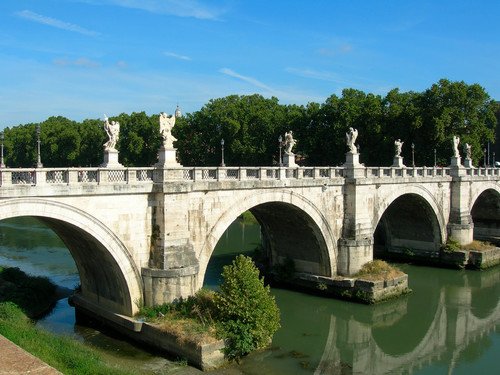
Ponte Sant'Angelo
Along with the tomb and the basilica came the pilgrims. Catholic pilgrims would travel thousands of miles to kiss the sacred ground, to pay homage to St. Peter, and to experience the presence of God in the holy place. Before the construction of the various bridges across the Tiber River, the pilgrims would all pass over the river through one route, the Ponte Sant’Angelo. The Bridge of the Angels was the only means of crossing the Tiber in the fifteenth century, which turned out to be hazardous and ultimately fatal. In 1450 one of the parapets gave out and 150 pilgrims fell into the river and drowned. At this time the bridge was crowded not only with pilgrims, but also with shops and stalls of vendors selling rosaries and other trinkets, clogging the flow of people. After the accident of 1450, Pope Sixtus IV removed the shops and added another bridge to widen the route for pilgrims. Another important difference in the pilgrim’s route was the small, dark, windy nature of the roads leading toward the church, rather than the broad, bright, direct route that we experience today in the Via della Conciliazone. The Bridge of the Angels gave the pilgrims’ their first glimpse of Michelangelo’s magnificent dome. After crossing the bridge they would once again be submerged in the dark streets of the crowded spina, unable to see the church again until reaching the piazza. Houses, shops, and other buildings made up the spina that occupied the space leading up to the basilica, obstructing the church from view until the sudden, final realization of the grand piazza and façade. This divine transition from dark to light embodied the element of “surprise” that is so reminiscent of baroque architecture.
The New St. Peter's
Over the centuries the church’s riches were stolen and destroyed and by the XVth century, after attempts at restoration and renovation the basilica was showing signs of wear. Whether or not it was necessary to tear down the church and build an entirely new one is debatable. Nevertheless, Julius II, with Donato Bramante as architect, razed the old basilica and began work on a new one in 1506. The destruction of the first church was incredibly controversial. There was a popular legend at the time of St. Peter rejecting Bramante at the gates to heaven because of the leading role he played in destroying Peter’s church. The New St. Peter’s Basilica went through over a century of different architects, contrasting visions for the church, and evolving plans for the various elements of the structure. The second St. Peter’s Basilica was finally consecrated in 1626 under Urban VIII.

Bernini's Piazza
As the largest and most important church in Christendom, St. Peter’s Basilica demanded a grand entrance. In this area outside the basilica the faithful would gather in crowds for festivals and to receive blessings. The creation of a monumental open place in front of the Vatican basilica had long been desired. When Alexander VII became pope, the area in front of the church was still open and unpaved. On July 31, 1656 Pope Alexander VII appointed Gianlorenzo Bernini to submit his ideas for the piazza and construction began in 1658. Bernini was faced with a series of challenges in creating his design. The façade was of awkward proportions, appearing too wide for its height. Maderno created the façade with the intention of having campanile on either end that would extend higher than the rest of the façade. However, this was canceled due to subsidence and the bell towers, no higher than the statues, were employed instead. The piazza functioned as a gathering place for tens of thousands of people. Bernini’s piazza can hold over 60,000 people. At the time of his commission the obelisk and Maderno’s fountain were already in place, which Bernini had to incorporate into his design as well.

Bernini’s solution to these challenges was what we see today, the Piazza Retta (a trapezoidal piazza) directly in front of the entrance, connected to the Piazza Obliqua (an elliptical piazza) which reaches out into the vast space in front of the church. The two foci of the ellipse are marked by two white disks located between the central obelisk and one of the two fountains on the northern and southern side of the obelisk. Bernini added the second fountain to the northern side of the piazza in 1675 to create balance, and enclosed the space with curved colonnades that reach around the northern and southern sides of the piazza.
The Obelisk
The obelisk was brought to Rome by Caligula in 37 AD from Heliopolis in Egypt. Moses and Abraham are believed to have walked past the obelisk in Egypt. According to popular tradition in the Middle Ages, the golden orb atop the needles was believed to contain the ashes of Julius Caesar. Upon thorough examination, this idea was later discredited. The obelisk stood for centuries on the southern side of the church, but there was a vision shared by the popes leading up to Sixtus V of having the obelisk placed in front of the basilica. In 1585 Domenico Fontana, under the order of Sixtus V, designed an elaborate contraption to have the 330 ton red granite obelisk moved a quarter mile to where it stands today. The technical operation employed hemp ropes, iron bars weighing 40,000 pounds, 900 men, 72 horses, and took about 5 months to complete. Thousands of spectators came to watch the incredible feat. The new placement of the obelisk symbolized the triumph of the Church over paganism. Sixtus V removed the golden orb and replaced it with a cross, and created a new base with an inscription that says, “Behold the Cross of the Lord! Flee adversaries, the Lion of Judah has conquered.” Encircling the obelisk are marks on the pavement, making up the Wind Rose, which is a diagram that uses the compass points to show the name and direction of the different winds. Surrounding the obelisk and throughout the piazza can be seen white slabs of travertine, which is the same stone used in the construction of the Coliseum, and which help to organize the sea of cobblestones.

The Colonnades
The embrace of the colonnades also brings a sense of order and definition to the space. The colonnades are four columns deep, wide enough to provide protection from the sun and rain for two carriages abreast. Bernini utilized his baroque theatricality in his design for the colonnades. The progression of the four rows of Doric columns, aligned as the spokes on the wheel of a circle centered about one of the two radii, create a dynamic sense of depth and movement for the viewer. The more distant rows of the darker and seemingly smaller columns seem to move backward as the front most line of columns, the brighter and seemingly larger ones, moves forward. A person standing on one of the foci and facing toward the corresponding arm of columns would view a perfectly aligned colonnade, giving the illusion that it is only one column deep. Inscriptions can also be seen inside the arms of the colonnade, inviting the viewer to ascend to the “mountain of the Lord” to worship in his holy temple. These words referred to a long tradition that likened Vatican hill with Mount Zion, the source of grace, orthodoxy, and all spiritual authority. Work on the colonnades took place between 1660 and 1667. Alexander VII died in May of 1667, shortly after which the south colonnade was completed. This explains why the papal arms of his successor, Clement IX, Rospigliosi hang there.
The Statues
Atop the two colonnades are 140 statues of saints, both male and female, which were designed and created by Bernini and his school. Construction of the statues began in 1662 and the last of the full group were finished 10 years later. The saints make up what is described as a “heavenly gathering” around the piazza, a symbol of triumph over death. The most accessible statues in the piazza, however, stand in the Piazza Retta on either side of the staircase leading up to the entrance to the church and were added two centuries later. On the right is a statue of Saint Paul done by Adamo Tadolini in 1838. On the left is a statue of Saint Peter added two years later by Giuseppe De Fabris. These were later additions to the piazza, separate from the major work that happened under Bernini.
The Spina, The Via della Conciliazione
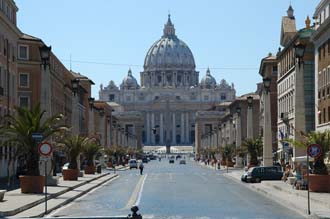
Bernini died in 1680, before the fate of the piazza and the spina was entirely settled. In 1667 Bernini projected a third arm that was removed from the oval by a distance large enough to establish a forecourt to the piazza. Different architects came up with ideas for incorporating this third arm, but the idea was eventually forsaken. Centuries later, the approach to the piazza became what it is today. The spina was destroyed ceremonially by Benito Mussolini in the year following October, 1936 as part of the Lateran Treaty of 1929; the agreements made between the Kingdom of Italy and the Holy See. The Via della Conciliazione, the thoroughfare leading toward the piazza, was completed in time for the Great Jubilee of 1950. The construction of the Via della Conciliazione forever changed Bernini’s vision for the approach to the basilica. All of the anticipation, mystery, and surprise realization of the grand piazza and basilica are lost. Today, pilgrims arriving at St. Peter’s Piazza see Michelangelo’s dome at the Bridge of the Angels and can continue to gaze at it, as well as the rest of the façade and piazza, without interruption throughout the journey from the bridge. There is a sort of impressive effect that this type of approach has as well, but it is most certainly nothing like the moment that the pilgrim’s experienced upon entering into the light of the piazza after wandering through the dark, windy streets of the spina.

Today
Today St. Peter’s Piazza, as the entrance to the great basilica, and a part of the Vatican, still marks the most significant destination for pilgrims in the Catholic word, as well as a must see for tourists throughout the secular world. The piazza functions as a space for people to gather every Sunday to receive the Pope’s blessing, which he delivers from the window of his apartment. Oftentimes there are flags and signs in the audience, either representing a nation, or attempting to bring to the pope’s attention certain issues. The space is occupied for other important events as well, such as the address given by each new pope upon being selected, from the Benediction Loggia located in the middle of the church’s façade. During the warmer months of the year, there is a service outdoors on the pavilion, for which chairs are set up and the Piazza Retta and the front most part of the Piazza Obliqua are blocked off from the general public.
St. Peter’s Piazza is a product of centuries of evolution within the church, as well as artistic and technological advancements in architecture. Originally gaining significance as the burial place of the king of the apostles, St. Peter’s Piazza is now teeming with layers of history and importance, reaching from early Christian tradition to contemporary politics. Today the piazza is one of the most recognizable locations in the world, highly revered spiritual centers, and desired tourist destinations. The uniquely engaging design of the piazza has for centuries sustained the intrigue and fascination evoked in the pilgrims and tourists who come to St. Peter’s and step into Bernini’s “motherly embrace”. The motifs behind Bernini’s design give the viewer an active role in their observation of the piazza, a responsibility to think in order to fully appreciate the magnificence that is the Piazza San Pietro.
Bibliography
1.
Bauer, George C. "Bernini's 'Pasce oves meas' and the Entrance Wall of St.
Peter's." Zeitschrift für Kunstgeschichte 63.1 (2000): 15-25. JSTOR. Web. 2
Jan. 2010.
ni's&term=Entrance&term=St.&list=hide&searchUri=/action/
doBasicSearch%3FQuery%3DBernini%2527s%2B%2522Pasce%2Boves%2Bmeas%2522%2Band%2Bthe
%2BEntrance%2BWall%2Bof%2BSt.%2BPeter%2527s%252C%2B%26wc%3Don%26dc%3DAll%2BDiscip
lines&item=1&ttl=4&returnArticleService=showArticle>.
2.
Boorsch, Suzanne. "The Building of the Vatican: The Papacy and Architecture."
The Metropolitan Museum of Art Bulletin 40.3 (1982-1983): n. pag.
JSTOR. Web. 2 Jan. 2010.
&list=hide&searchUri=/action/
doBasicSearch%3FQuery%3DThe%2BBuilding%2Bof%2Bthe%2BVatican%253A%2BThe%2BPapacy%2
Band%2BArchitecture%26wc%3Don%26dc%3DAll%2BDisciplines&item=1&ttl=607&returnArtic
leService=showArticle&resultsServiceName=doBasicResultsFromArticle>.
3.
Campbell, Ian. "The New St Peter's: Basilica or Temple?" Oxford Art Journal 4.1
(1981): 3-8. JSTOR. Web. 3 Jan. 2010.
st=hide&searchUri=/action/
doBasicSearch%3FQuery%3DThe%2BNew%2BSt%2BPeter%2527s%253A%2BBasilica%2Bor%2BTempl
e%253F%26wc%3Don%26dc%3DAll%2BDisciplines&item=1&ttl=57729&returnArticleService=s
howArticle>.
4.
Holly Hayes. "St. Peter's Basilica, Rome." Sacred Destinations. N.p., 2005. Web.
5 Feb. 2010.
5.
Kuntz, Margaret. "Designed for Ceremony: The Cappella Paolina at the Vatican
Palace." Journal of the Society of Architectural Historians 62.2 (2003):
228-255. JSTOR. Web. 1 Jan. 2010.
aolina&term=Palace&list=hide&searchUri=/action/
doBasicSearch%3FQuery%3DDesigned%2Bfor%2BCeremony%253A%2BThe%2BCappella%2BPaolina
%2Bat%2Bthe%2BVatican%2BPalace%26wc%3Don%26dc%3DAll%2BDisciplines&item=1&ttl=17&r
eturnArticleService=showArticle>.
6.
Magnuson, Torgil. Rome in the Age of Bernini. Vol. 2. New Jersey: Humanities Press, 1986. Print.
7.
Marder, T.A. Bernini & the Art of Architecture. Abbeville Press Publisher, 1998. Print. P. 126-149
8.
McClendon, Charles B. "The History of the Site of St. Peter's Basilica, Rome."
Perspecta 25 (1989): 33-65. JSTOR. Web. 2 Jan. 2010.
term=St.&list=hide&searchUri=/action/
doBasicSearch%3FQuery%3DThe%2BHistory%2Bof%2Bthe%2BSite%2Bof%2BSt.%2BPeter%2527s%
2BBasilica%252C%2BRome%26wc%3Don%26dc%3DAll%2BDisciplines&item=3&ttl=737&returnAr
ticleService=showArticle>.
9.
Morrissey, Jake. The Genius in the Design Bernini, Borromini, and the Rivalry That Transformed Rome. Grand Rapids: William Morrow, 2005. Print.
10.
Vicchi, Roberta. The Major Basilicas of Rome: Saint Peter’s, San Giovanni, San Paolo, Santa Maria Maggiore. Poligrafiche Bolis, 1999.

No comments:
Post a Comment